 Aditya Mishra
Most products do not die because the idea was bad.
They die because the first version never reached the people it was meant to help.
They die inside Notion pages, Figma files, GitHub branches, pitch decks, and endless discussions about what the “perfect” version should look like.
The design needs one more revision.
The model needs one more improvement.
The backend needs one more refactor.
The feature list needs one more addition.
The team needs one more week.
And slowly, the product becomes more imaginary than real.
That is the danger of perfection.
It makes you feel productive while keeping you away from the only thing that can truly judge your product: the user.
The first version is not supposed to be perfect
The first version of a product is not meant to be your masterpiece.
It is meant to be your first conversation with reality.
That is what an MVP really is.
A Minimum Viable Product is not a cheap product.
It is not a careless product.
It is not an excuse to ship something broken.
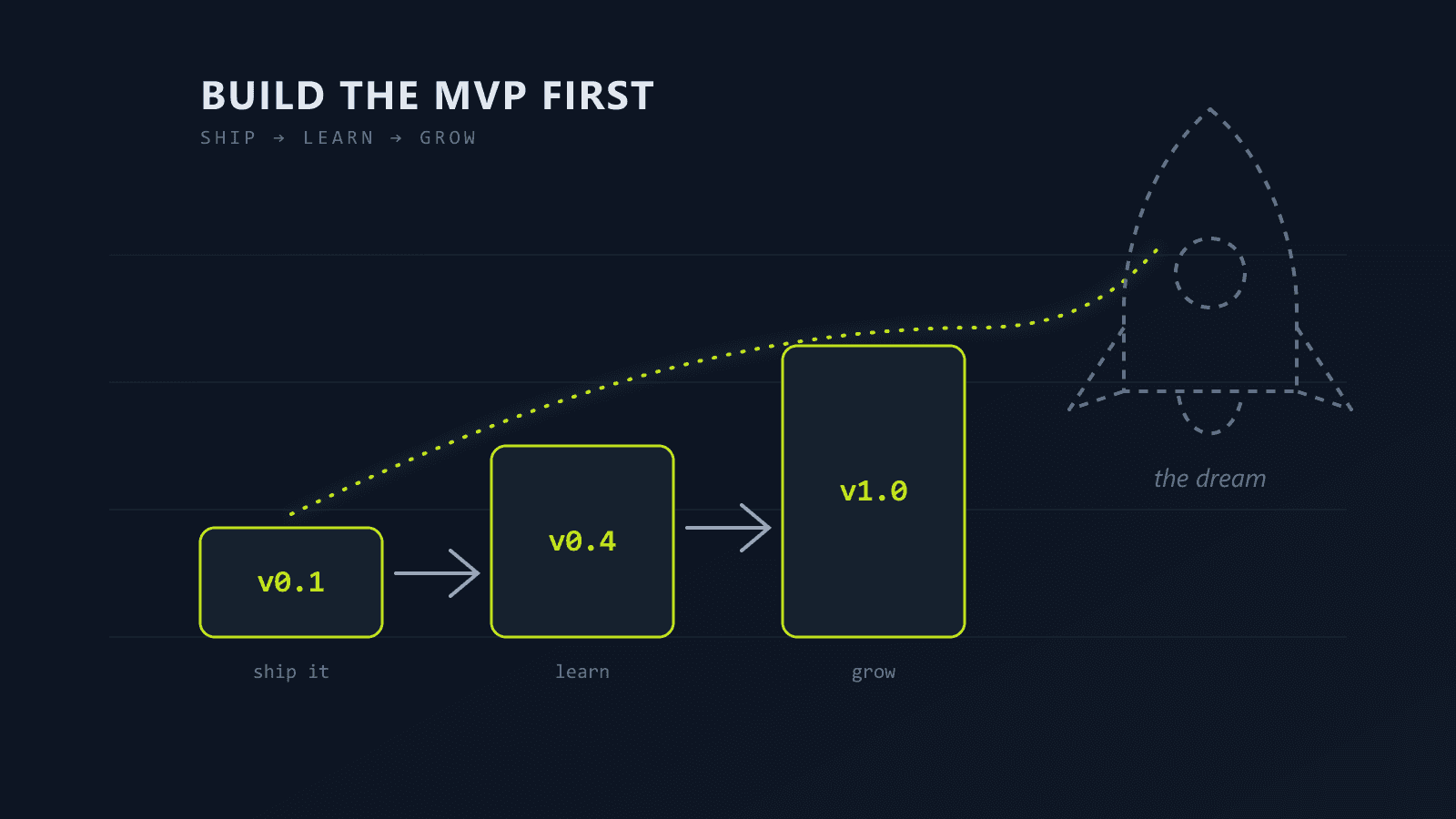
An MVP is the smallest responsible version of your idea that can be used by real people and can teach you what to build next.
That word matters: responsible.
An MVP should still respect the user. It should still solve a real problem. It should still be honest about what it can and cannot do.
But it does not need to contain every feature you imagined.
It does not need to look like the final product.
It does not need to impress everyone.
It only needs to answer one question:
Does this actually create value for someone?
Perfection before launch is often fear in disguise
When we say, “It is not ready yet,” sometimes we are right.
But sometimes, we are hiding.
We are hiding from feedback.
We are hiding from rejection.
We are hiding from the possibility that users may not care.
We are hiding from the discomfort of seeing our beautiful idea behave differently in the real world.
This happens even more when you deeply care about what you are building.
You want the product to be clean.
You want the UI to look polished.
You want the model to be accurate.
You want the architecture to be scalable.
You want the experience to feel premium.
And none of that is wrong.
Quality matters.
But in the early stage, the biggest risk is usually not that your product is imperfect.
The biggest risk is that you spend months perfecting something nobody actually wants.
Reality gives better feedback than imagination
Before a product reaches users, every decision is partly a guess.
You guess what users will like.
You guess what they will ignore.
You guess which feature matters.
You guess what problem is most painful.
You guess what “quality” means to them.
Then you ship the first usable version, and reality starts correcting you.
The button you thought was obvious gets ignored.
The feature you treated as secondary becomes the main reason people care.
The feature you spent days polishing barely gets noticed.
The model does not need another 2 percent improvement; it needs to be faster.
The dashboard does not need more charts; it needs one clear answer.
The product does not need ten workflows; it needs one workflow that works.
That is the power of an MVP.
It turns assumptions into evidence.
The companies we admire did not start perfectly
It is easy to look at successful companies today and assume they were always polished.
They were not.
Airbnb did not begin as a global travel platform with millions of listings and a refined booking experience. It began with a simple idea: people needed a place to stay, and some people had space to offer. The early version was rough, small, and far from the platform we know today.
Dropbox did not first build a massive finished product and then ask people if they wanted it. Its early validation came through a demo video that showed the idea clearly. That video helped prove demand before the company invested years into building everything at full scale.
Buffer did not start as a complete social media management suite. It began with a simple two-page MVP to check whether people even cared about the idea. The goal was not to look like a big company. The goal was to learn whether the problem was real.
DoorDash did not begin with a giant logistics engine. Its earliest version was a simple local delivery experiment with menus and manual operations. It did not need to be elegant at first. It needed to prove that restaurants and customers actually wanted the service.
Zappos did not begin with huge warehouses and perfect inventory systems. The early experiment was much simpler: test whether people were willing to buy shoes online. The system behind it was manual, but the learning was real.
Gmail stayed in beta for years while users were already using it. It kept evolving in public instead of waiting for some mythical perfect state.
This is the pattern.
Great products rarely begin as great products.
They begin as useful products.
Then they listen.
Then they improve.
MVP does not mean building less seriously
Some people misunderstand MVPs.
They think MVP means building something low quality.
That is not the point.
MVP does not mean low effort.
MVP does not mean bad design.
MVP does not mean weak engineering.
MVP does not mean ignoring reliability.
MVP does not mean disrespecting users.
MVP means reducing the scope until the core value becomes testable.
You are not cutting quality.
You are cutting assumptions.
You are not removing responsibility.
You are removing unnecessary complexity.
You are not saying, “This is all the product will ever be.”
You are saying, “This is the smallest version that can start teaching us the truth.”
That is a very different mindset.
My biggest realization while working inside a startup
When you work in a startup environment, this lesson becomes real very quickly.
You may join as an intern, but the work does not always feel like internship work.
The thing you build may enter a demo.
The model you train may influence a product decision.
The script you write may save someone hours.
The prototype you create may become the foundation for the next version.
That is when you understand something important:
You are not just writing code.
You are helping move an idea closer to the real world.
And the real world does not care about how perfect the plan looked.
It cares whether the product works when someone needs it.
It cares whether the user understands it.
It cares whether it solves the problem better than what existed before.
It cares whether the team can learn from it and improve.
That is why MVP matters so much.
Because in a startup, speed is not about rushing.
Speed is about learning before your assumptions become expensive.
The MVP is the first proof of seriousness
A perfect-looking plan can hide a weak idea.
A rough MVP cannot hide for long.
Once users touch it, the truth starts appearing.
Do they understand it?
Do they use it again?
Do they ask for it?
Do they complain about something specific?
Do they find value despite its limitations?
Do they care enough to give feedback?
That feedback is gold.
Because vague praise before launch is cheap.
Real behavior after launch is expensive truth.
People may say an idea is nice.
But when they use it, ignore it, return to it, pay for it, recommend it, or abandon it, they reveal what they actually believe.
That is why an MVP is not a small thing.
It is the first serious test of whether your product deserves to exist.
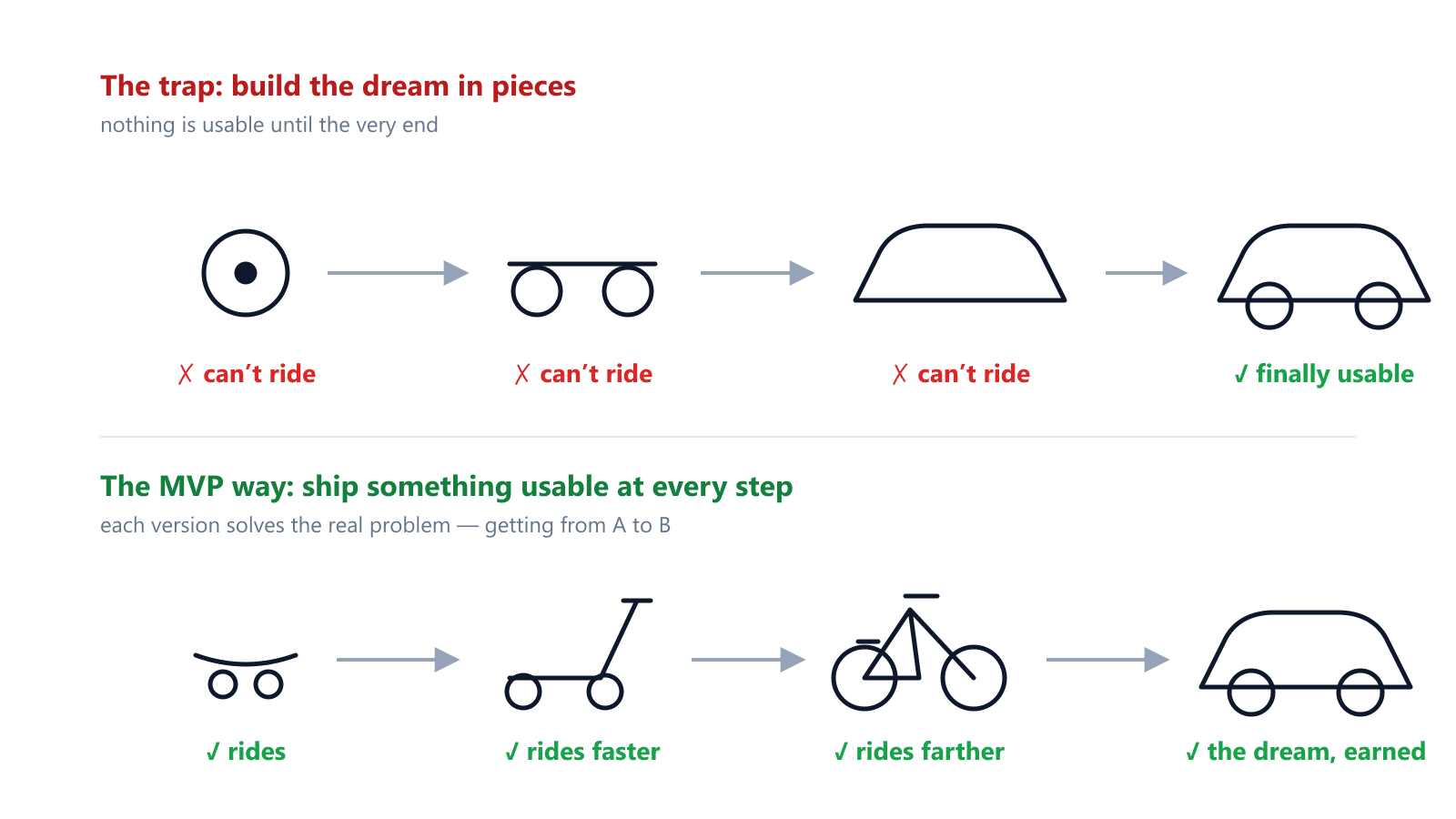
Do not build the palace before testing the door
Imagine spending months building a palace.
Beautiful walls.
Perfect rooms.
Detailed interiors.
Premium lighting.
Elegant furniture.
Then people arrive, and you realize the entrance is in the wrong place.
That is what happens when teams overbuild before validating the core user behavior.
An MVP is like testing the door first.
Can people enter?
Do they want to enter?
Do they understand why they are entering?
Do they come back after entering once?
Only after that does it make sense to build the palace.
The first version creates momentum
A shipped MVP does something that private perfection never can.
It creates momentum.
It gives the team something real to discuss.
It gives users something real to react to.
It gives developers real bugs to fix.
It gives designers real behavior to observe.
It gives founders real signals to follow.
It gives the product a pulse.
Without an MVP, everything remains theoretical.
With an MVP, the product becomes alive.
And once something is alive, it can grow.
Build small, but build with intent
The goal is not to ship anything blindly.
The goal is to ship the smallest meaningful thing.
A good MVP should be clear about three things:
What problem are we solving?
Who are we solving it for?
What is the simplest version that proves whether this matters?
If the MVP cannot answer these questions, it may just be a rushed product.
But if it can, then even a small version becomes powerful.
Because the goal of the first version is not perfection.
The goal is direction.
The product improves only after it meets the user
You can improve a product in private, but only up to a point.
After that, you need reality.
You need people to misunderstand it.
You need people to use it differently than expected.
You need people to complain.
You need people to ask for features.
You need people to expose weak points.
You need people to show you what actually matters.
That is not failure.
That is product development.
The first version is not the end of the journey.
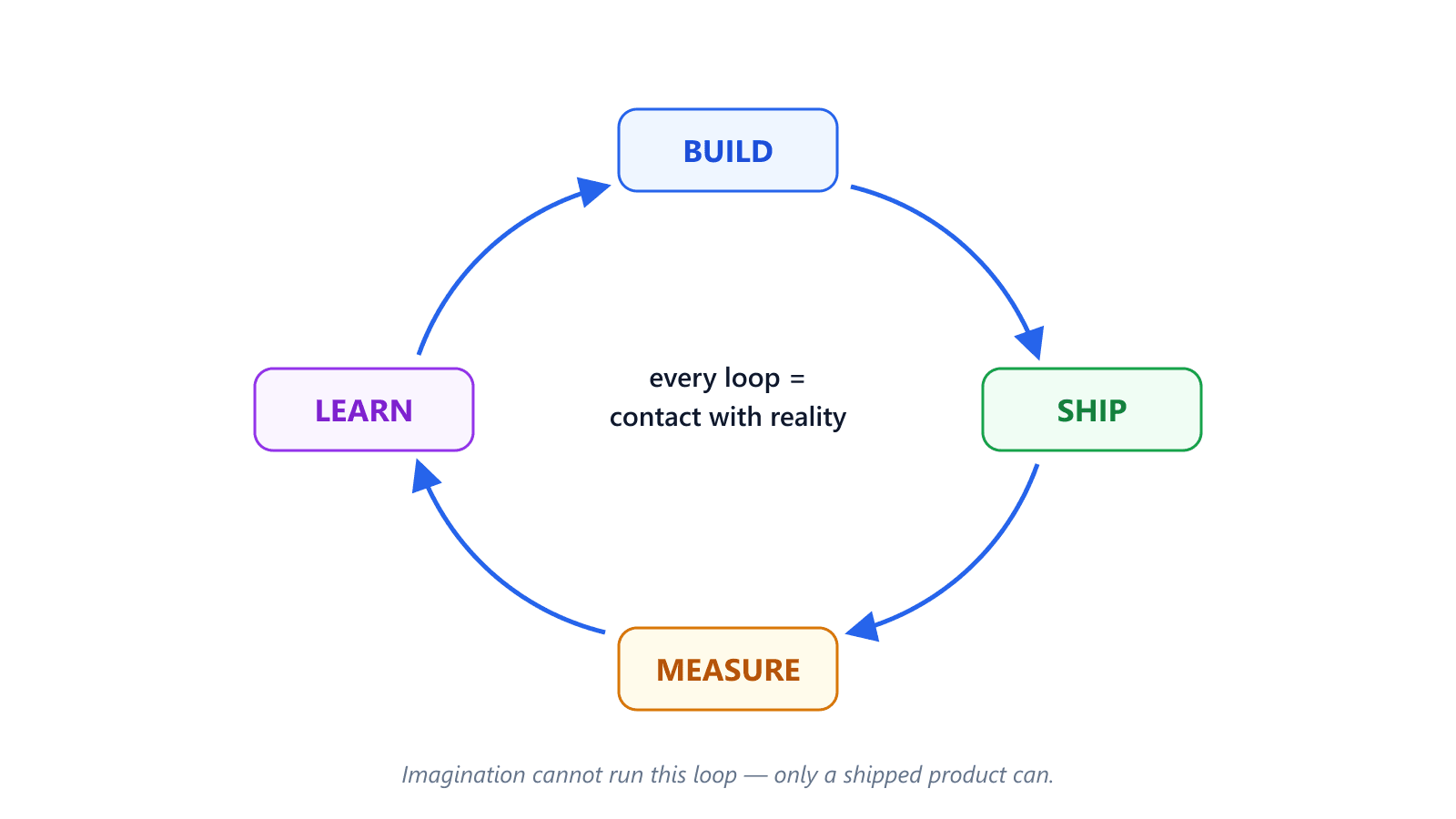
It is the beginning of the feedback loop.
Build.
Ship.
Measure.
Learn.
Improve.
Repeat.
This is how real products are made.
The MVP is not smaller than the dream
Many people think building an MVP means thinking small.
I think it means thinking clearly.
The dream can be big.
The vision can be ambitious.
The final product can be world-class.
But the first step must be small enough to move.
A big vision without a first version is just imagination.
A small MVP with real users is momentum.
And momentum is what turns ideas into products.
Conclusion: Ship the truth
The perfect version of your product lives in your head.
The real version lives in the hands of users.
That is why the MVP is not optional.
It is the foremost requirement.
It is the bridge between idea and evidence.
It is the difference between believing and knowing.
It is the point where your product stops being a concept and starts becoming a reality.
So build carefully.
But build.
Improve constantly.
But ship.
Respect quality.
But do not worship perfection so much that your product never meets the people it was meant for.
Because the world cannot use your perfect idea.
It can only use what you are brave enough to release.