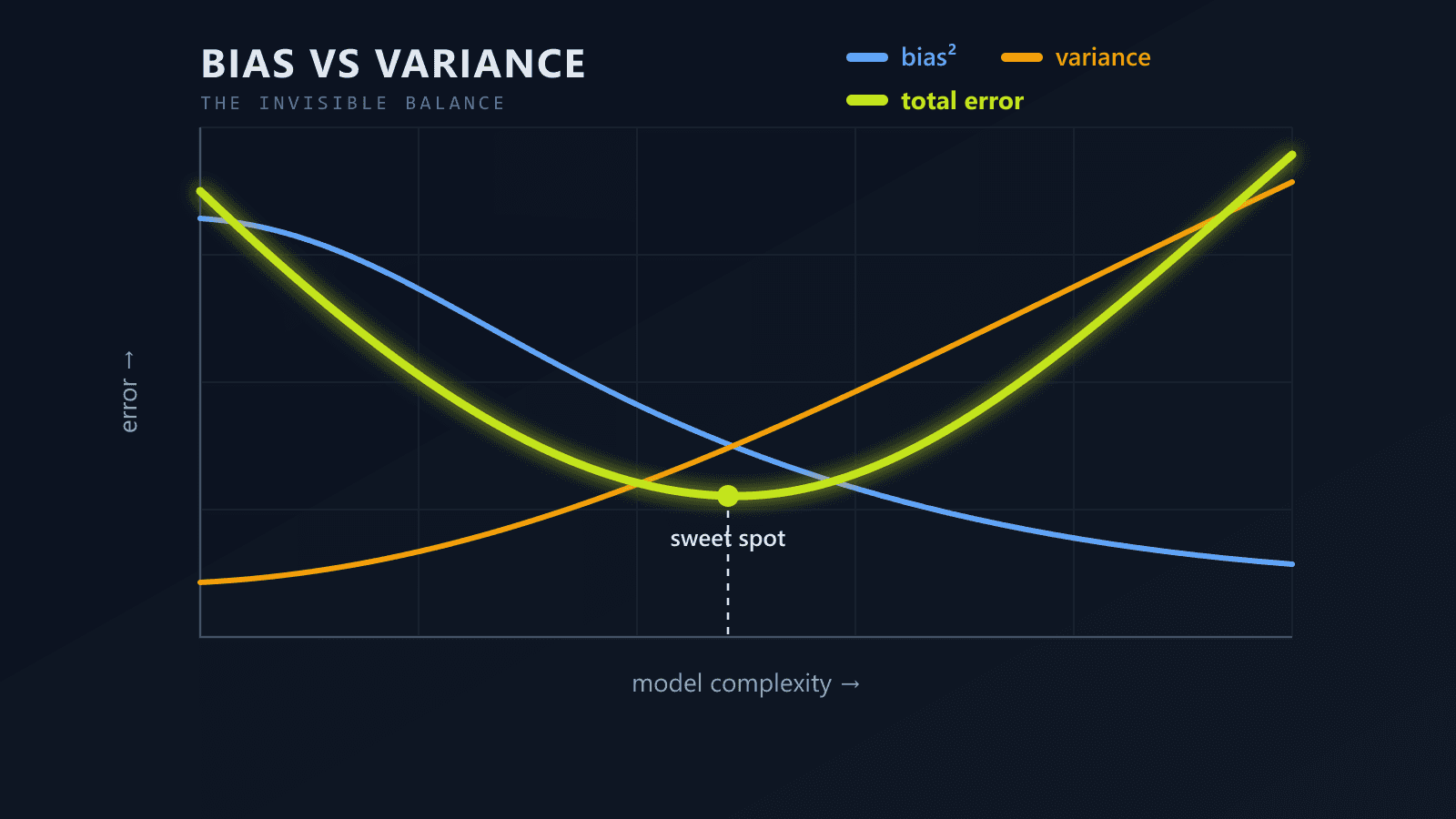
 Aditya Mishra
Imagine two students preparing for the same exam. One student barely studies and believes every question will be simple. He learns only the basic formulas and ignores the deeper concepts. When the exam arrives, he struggles because the paper is more complex than expected. The second student does the opposite. She memorizes every solved example from the textbook, including the exact numbers and steps. But when the exam asks a slightly different question, she freezes because she memorized examples instead of understanding the idea.
Both students fail, but for completely different reasons. The first student learned too little. The second student learned too specifically. This is exactly what happens in machine learning when we talk about bias and variance. A model with high bias is too simple to understand the real pattern. A model with high variance is so flexible that it starts memorizing noise instead of learning the actual relationship.
Good machine learning is not just about making a model learn. It is about making the model learn the right things.
What is bias?
Bias is the error that comes from overly simple assumptions. A high-bias model already has a limited view of the problem before it even begins learning. It tries to force the data into a simple pattern, even when the real pattern is more complex.
For example, imagine the true relationship in your data is curved, but you try to fit it using a straight line. No matter how much you train that model, the straight line will never fully capture the curve. The model is not failing because it is lazy; it is failing because it does not have enough flexibility to represent the truth.
This is called underfitting. An underfitting model performs badly on training data and also badly on unseen data. It has not learned the training data properly, so there is very little chance that it will perform well in the real world.
A high-bias model is like a student who oversimplifies every question. Even when the problem requires depth, the model keeps giving a shallow answer.
What is variance?
Variance is the error that comes from being too sensitive to the training data. A high-variance model does not just learn the general pattern; it also learns random fluctuations, noise, and accidental details that exist only in that specific dataset.
This leads to overfitting. An overfitting model performs very well on training data but fails when it sees new data. The model looks impressive at first because the training accuracy may be very high, but that performance is misleading. It has not learned the problem. It has learned the dataset.
Think of a student who memorizes every example in the book. If the exam repeats the same questions, she performs perfectly. But if the question changes even slightly, she struggles. That is high variance. The knowledge is too attached to the examples and not general enough to handle new situations.
In machine learning, this is dangerous because overfitting often looks like success during training. You may see 99% training accuracy and feel confident, but the real test begins only when the model faces unseen data.
The real goal is generalization
Machine learning is not about performing well on the data the model has already seen. That is only practice. The real goal is generalization, which means performing well on new, unseen data.
A model with high bias cannot generalize because it has not learned enough. A model with high variance cannot generalize because it has learned too much from the wrong details. The best model lies somewhere between these two extremes. It should be flexible enough to capture real patterns, but not so flexible that it starts treating noise as truth.
This balance is called the bias-variance tradeoff. If the model is too simple, bias dominates. If the model is too complex, variance dominates. The goal is not to remove both completely, because that is usually impossible. The goal is to find the point where the model understands the pattern without becoming a prisoner of the training data.
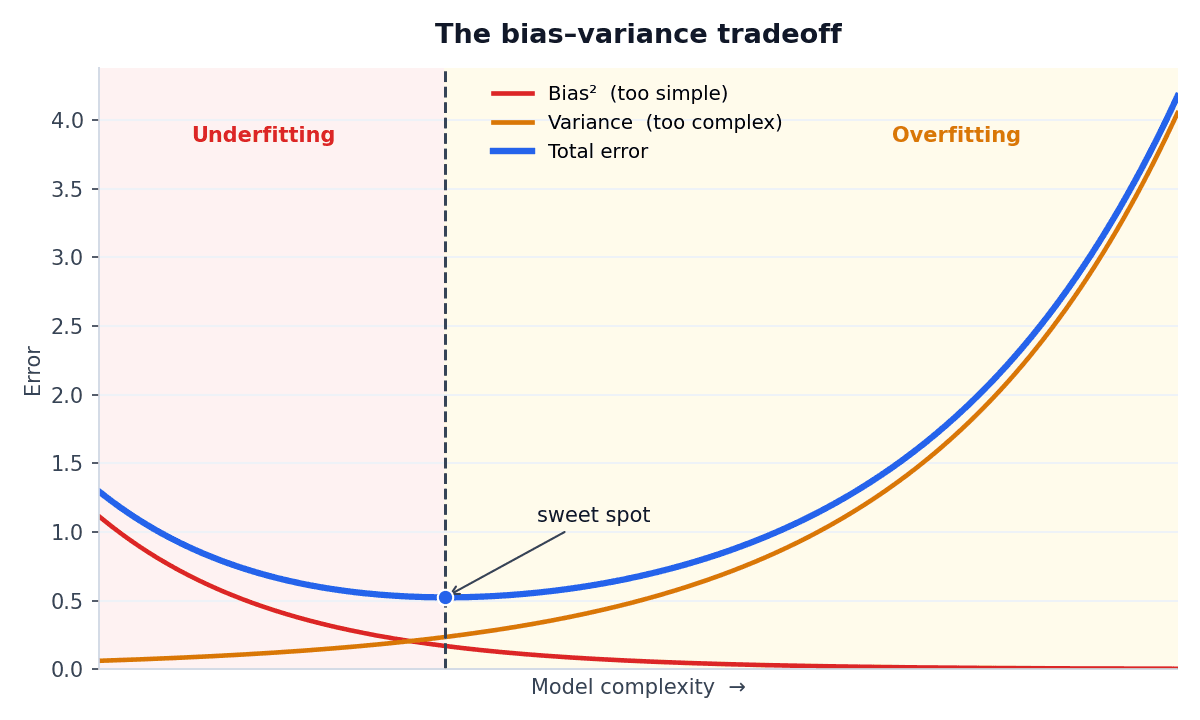
A simple example
Suppose you are predicting house prices. A high-bias model may say that price depends only on the size of the house. This is too simple because house price also depends on location, number of rooms, age of the property, nearby facilities, parking, floor number, and demand in that area.
A high-variance model may go too far in the opposite direction. It may start treating random details as important, such as the color of the gate, whether the house was listed on a Monday, or whether one unusual house sold at an unusually high price. These details may exist in the training data, but they may not represent real patterns.
A good model learns the meaningful factors without becoming obsessed with every small accident in the data. It understands that size and location matter, but it does not assume that every random detail is a rule.
Seeing bias and variance with code
One of the easiest ways to understand bias and variance is through polynomial regression. In the example below, we create data that follows a curved pattern and then try to fit models of different complexity.
import numpy as np
import matplotlib.pyplot as plt

from sklearn.preprocessing import PolynomialFeatures
from sklearn.linear_model import LinearRegression
from sklearn.pipeline import make_pipeline

np.random.seed(42)

X = np.linspace(0, 10, 50)
y = np.sin(X) + np.random.normal(0, 0.2, size=X.shape)

X_train = X.reshape(-1, 1)
X_test = np.linspace(0, 10, 200).reshape(-1, 1)

degrees = [1, 3, 15]

plt.scatter(X, y, label="Training Data")

for degree in degrees:
    model = make_pipeline(
        PolynomialFeatures(degree),
        LinearRegression()
    )
    model.fit(X_train, y)
    y_pred = model.predict(X_test)

    plt.plot(X_test, y_pred, label=f"Degree {degree}")

plt.title("Bias vs Variance using Polynomial Regression")
plt.xlabel("X")
plt.ylabel("y")
plt.legend()
plt.show()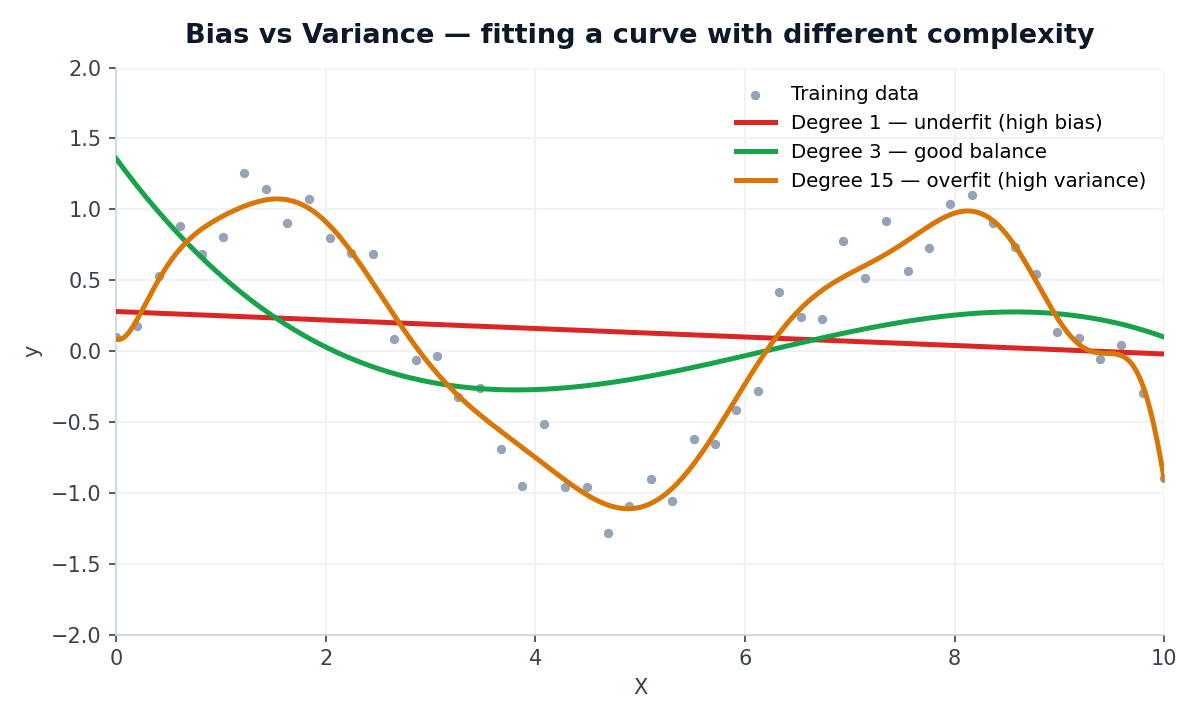
In this example, the degree 1 model is too simple. It cannot capture the curve properly, so it has high bias. The degree 15 model is too flexible. It may bend too much and start following the noise in the training data, so it has high variance. The degree 3 model usually gives a better balance because it is flexible enough to capture the trend without memorizing every small fluctuation.
This is the entire idea of bias and variance in a visual form. Too simple, and the model misses the pattern. Too complex, and the model memorizes noise.
Training error vs validation error
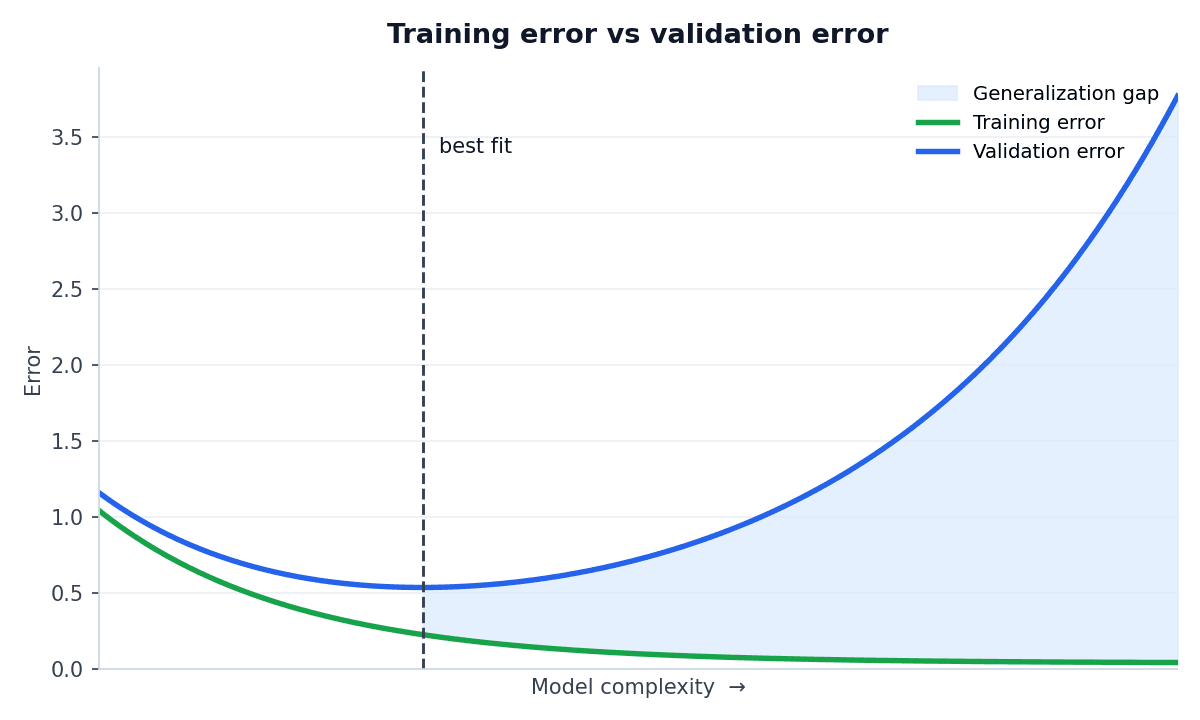
A practical way to identify bias and variance is by comparing training error and validation error.
| Situation | Training Error | Validation Error | Meaning |
|---|---|---|---|
| High bias | High | High | Model is underfitting |
| High variance | Low | High | Model is overfitting |
| Good fit | Low | Low | Model generalizes well |
If both training and validation errors are high, your model is probably too simple. It has not learned the training data properly, so you may need a more powerful model, better features, or less regularization.
If training error is low but validation error is high, your model is probably too complex. It has learned the training data too closely and is failing to generalize. In this case, you may need more data, regularization, dropout, early stopping, cross-validation, or a simpler model.
This gap between training and validation performance is called the generalization gap. A large gap is usually a warning sign that the model may be overfitting.
Bias and variance in real projects
In real machine learning projects, the bias-variance tradeoff is not always as clean as textbook diagrams. Poor performance can come from many places. The model may be too simple, but the data may also be noisy. The model may be too complex, but the validation split may also be weak. Sometimes the issue is not the algorithm at all, but inconsistent labels, poor preprocessing, data leakage, or a mismatch between training data and real-world data.
For example, imagine building a model to detect whether someone is wearing a small medical patch near the neck. If all training images are captured in similar lighting, similar angles, and similar backgrounds, the model may perform well during training. But once it sees real-world images with different lighting, camera quality, skin tones, head positions, or patch placements, its performance may drop. This is not just an accuracy issue. It is a generalization issue.
That is why a good machine learning engineer does not only ask, “How can I improve accuracy?” A better question is, “Why is the model making this kind of error?” Once you understand whether the problem is bias, variance, data quality, or evaluation design, you can fix the right thing.
The best model is not always the most complex one
A common beginner mistake is assuming that a more advanced model is always better. A neural network is not automatically better than logistic regression. A transformer is not automatically better than a random forest. A larger model is not automatically better than a smaller model.
The best model depends on the problem, the data, the deployment constraints, and the kind of generalization required. Sometimes a simple model works better because it is stable and less likely to overfit. Sometimes a complex model is necessary because the underlying pattern is genuinely complex.
The goal is not to use the fanciest model. The goal is to use the right model.
Quick rules of thumb
When you are diagnosing a model, this short checklist usually points you to the real problem:
- High training error and high validation error → high bias (underfitting). Reach for a more powerful model, better features, or less regularization.
- Low training error but high validation error → high variance (overfitting). Reach for more data, regularization, early stopping, cross-validation, or a simpler model.
- Low training error and low validation error → a good fit. Ship it, then keep monitoring on fresh data.
- Always judge a model on unseen data, never on training accuracy alone.
Conclusion: the balance is the model
Bias and variance are two forces pulling every machine learning model in opposite directions. Bias pushes the model toward simplicity. Variance pushes the model toward sensitivity. Too much bias, and the model misses the real pattern. Too much variance, and the model memorizes noise.
A good model lives between these two extremes. It is flexible, but not chaotic. It is simple, but not blind. It learns from data, but it does not become trapped by the data.
That is the real art of machine learning. Not just building a model that performs well today, but building one that still performs well when tomorrow’s data looks a little different.